How to Pass Driving Test in Slough
April 25, 2026
How to Pass Driving Test in Slough
Passing your driving test is one of the most exciting things you can do. It gives you freedom to go wherever you want, whenever you want. But many people find it scary or confusing, especially if they do not know what to expect.
The average driving test pass rate in Slough is around 43-47%, which means less than half of people pass on their first try. But do not worry. With the right preparation, you can be one of the people who pass the first time.
In this guide, we will walk you through everything step by step. From learning to drive, to booking your test, to what happens on test day. By the end, you will know exactly what to do.
What Is the Driving Test in Slough?
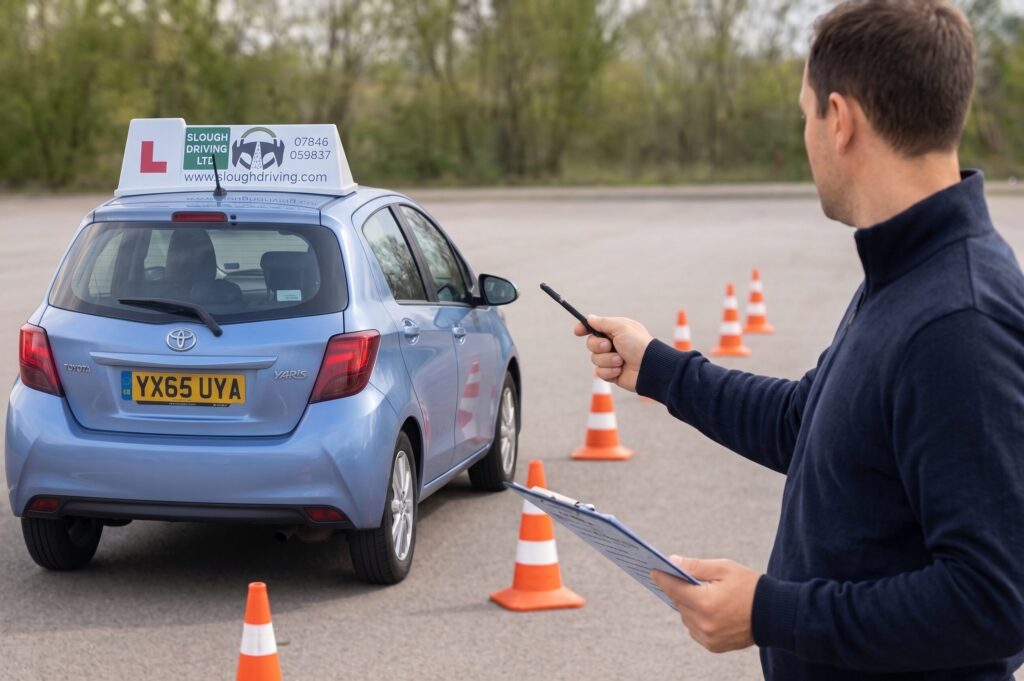
The driving test in Slough is run by the DVSA (Driver and Vehicle Standards Agency). This is the official government body that tests all drivers in the UK. The test checks that you can drive safely on real roads, not just in a car park.
What the DVSA Driving Test Includes
The full practical driving test lasts about 40 minutes. It has four main parts:
- Eyesight test: You read a number plate from 20 metres away. If you fail this, the test stops right there.
- “Show me, tell me” questions. The examiner asks you two simple car safety questions. For example: “How would you check the oil level?” or “Show me how you wash the windscreen.”
- General driving, you drive around Slough roads while the examiner watches how safely you drive. This is the longest part of the test.
- Independent driving. For about 20 minutes, you follow sat-nav directions or road signs on your own, without the examiner telling you where to go.
Driving Test Requirements in the UK
Before you can book your practical driving test, you need to meet some important requirements. Missing any of these means you cannot take the test.
What You Need Before Booking
- Provisional driving licence. You must have a valid UK provisional licence. You can get this from the DVLA online. It costs around 34 pounds.
- Theory test pass certificate. You must pass your theory test BEFORE you can book the practical test. The theory test has two parts: multiple choice questions and a hazard perception video test.
- Minimum age: You must be at least 17 years old to take the driving test in the UK.
- Booking the test. You can book your driving test online at gov.uk or by phone. The test currently costs 62 pounds on weekdays and 75 pounds on evenings and weekends.
Tip: Make sure you pass your theory test first. Read our full Theory Test Guide to learn how to prepare properly.
Step-by-Step Process to Pass Driving Test
Follow these five simple steps and you will give yourself the best possible chance of passing your driving test in Slough.
Step 1: Learn Basic Driving Skills
Start with the basics. Learn how to control the steering wheel smoothly, use the clutch properly (for manual cars), change gears without looking down, and control the speed with the accelerator and brake. These skills take time, but they are the foundation of everything else. Do not rush this step.
Step 2: Take Professional Driving Lessons
A good driving instructor makes a huge difference. They know the Slough test routes, the local roads, and the exact things the examiner looks for. Trying to learn only from a parent or friend is risky because they may teach you bad habits without knowing it. Always take lessons with a qualified DVSA-approved instructor.
Step 3: Pass Your Theory Test
You cannot book your practical test without a pass in the theory test. Study the Highway Code carefully. Use the official DVSA app to practise mock tests. Focus on hazard perception, too, because many people fail this part. Give yourself at least 4-6 weeks of daily study before sitting the theory test.
Step 4: Practise Test Routes in Slough
Knowing the roads near the Slough test centre gives you a big advantage. You will already know which roads are tricky, where the busy roundabouts are, and which junctions need extra care. Ask your instructor to practise the most common test routes with you. Familiarity helps you feel calm and confident on test day.
Step 5: Take Mock Driving Tests
A mock driving test is a pretend test done with your instructor. It copies the real test exactly. This helps you get used to being watched and judged. It also shows you which areas still need improvement. Try to do at least two or three mock tests before your real test day.
Common Driving Test Mistakes (And How to Avoid Them)
Most people who fail their driving test make the same mistakes. Here are the most common ones. Read our detailed article on the Top 20 Reasons You Fail for more help.
Mistakes to Watch Out For
- Not checking mirrors: You should check your mirrors every 5-8 seconds while driving. Also, check mirrors before you change speed, change direction, or signal. Forgetting this is one of the top reasons people fail.
- Poor junction observations: At every junction, look right, left, then right again. Take your time. Do not pull out too quickly. Many accidents happen at junctions, so examiners watch this very carefully.
- Incorrect lane positioning: Stay in the correct lane at all times. Do not drift between lanes or position your car too close to the curb or the centre line. This shows a lack of control.
- Lack of control: Stalling the car, rolling back on a hill, or making sudden movements can all lead to a failure. Stay calm and take your time with each manoeuvre.
Key Driving Skills You Must Master
These are the skills the examiner will be watching most closely. Practise each one until you can do it confidently without thinking too hard.
Essential Skills for Test Day
- Parallel parking: Park your car parallel to the curb, behind another parked vehicle. Take it slowly and use your mirrors constantly. Read our full parallel parking guide for step-by-step help.
- Bay parking: Park neatly in a marked bay, either by driving in or reversing in. Keep the car straight and within the lines. Check our bay parking guide for detailed instructions.
- Roundabouts: Choose the correct lane before you reach the roundabout. Give way to traffic from the right. Signal correctly when you are about to exit. Slough has several busy roundabouts on the test routes.
- Lane discipline: Always be in the right lane. Do not change lanes without checking mirrors and signalling first. On dual carriageways, keep to the left lane unless overtaking.
- Emergency stop: When the examiner signals, stop as quickly and safely as possible. Do not brake so hard that you skid. Keep both hands on the wheel and do not panic.
Slough Driving Test Routes & Local Tips
Knowing Slough’s roads before test day is a massive advantage. Local knowledge can save you from making mistakes on roads you have never seen before.
About Slough Driving Test Centre
The Slough driving test centre is located in the heart of the town. Tests cover a wide range of local roads, including residential areas, dual carriageways, and town centre roads. Common roads used in tests include the A4 Bath Road, Farnham Road, and Stoke Poges Lane. Difficult spots to watch out for include the Tuns Lane roundabout, junctions on Windsor Road, and the busy traffic lights near Slough town centre. The best areas to practise are quieter residential streets in Langley and Colnbrook before moving on to the busier main roads.
How Many Driving Lessons Do You Need to Pass?
The Average Number of Lessons
The DVSA says the average learner needs about 45 hours of professional driving lessons, plus 22 hours of private practice with a family member. Of course, every person is different. Some people learn faster, and some need more time. Do not compare yourself to others.
Factors that affect how quickly you learn include your age, your natural confidence, how often you practise, and how consistent your lessons are. Weekly lessons of 1-2 hours are good for most people. However, if you want to learn faster, intensive driving courses (4-6 hours per day for 1-2 weeks) can help you pass in a shorter time.
Tips to Pass Driving Test First Time
Here are some practical tips that can help you pass your driving test in Slough on the very first attempt.
How to Stay Calm and Focused
- Stay calm during the test: Nerves are normal. Take slow, deep breaths. Remember, the examiner is not trying to fail you. They want you to pass, but only if you are genuinely safe.
- Follow examiner instructions carefully: Listen closely to every word the examiner says. If you do not understand something, it is perfectly fine to ask them to repeat it.
- Avoid rushing decisions: Take your time at junctions and roundabouts. It is better to wait a few extra seconds than to pull out unsafely.
- Practise consistently: Two or three lessons per week is better than one. The more you drive, the more natural it feels.
What Happens If You Fail Your Driving Test?
Failing your driving test feels disappointing, but it is very common. Do not give up. Many excellent drivers failed their first test.
What to Do After a Failed Test
- Rebooking process: You can rebook your test online as soon as you like. You must wait at least 10 working days before your next test.
- Waiting time: Test centre slots in Slough can sometimes be booked up weeks in advance, so rebook quickly.
- Improving weak areas: After the test, your examiner will give you a feedback sheet showing every fault. Read it carefully with your instructor and focus your next lessons on fixing those specific problems. Read our article on Fail Reasons for help understanding what went wrong.
Driving Test Checklist (Before Test Day)
Use this simple checklist to make sure you are fully ready before you arrive at the test centre.
Documents and Car Requirements
- Documents required: Bring your UK provisional driving licence (both parts if you have an old-style licence with a paper counterpart). You do not need to bring your theory test pass certificate.
- Car requirements: The car must be roadworthy, insured for a driving test, and have a working headrest and seatbelt for the front passenger (examiner). Your instructor’s car is usually already set up for this.
- What to bring: Your provisional licence. Glasses or contact lenses if you need them to drive. Wear comfortable clothes and shoes that you can drive in easily.
- Mental preparation: Get a good night’s sleep. Eat a proper meal before your test. Arrive 10 minutes early so you are not rushing. Have a short warm-up drive with your instructor before the test begins, if possible.
Manual vs Automatic - Which Is Easier to Pass?
Many people ask whether they should learn in a manual or automatic car. Both have advantages. Automatic cars are easier to drive because you do not need to worry about the clutch or changing gears. This means you can focus more on the road. However, if you pass in an automatic, your licence will only allow you to drive automatic cars. If you pass in a manual, you can drive both manual and automatic vehicles. Read our detailed Manual vs Automatic guide to help you decide which is right for you.
Choosing the Right Driving Instructor in Slough
Your driving instructor is the most important person in your driving journey. A great instructor will build your confidence, teach you the right habits, and help you pass faster.
Qualities of a Good Instructor
- DVSA approved (ADI qualified): Always check your instructor has a green ADI badge in the car window. This means they are fully qualified.
- Patient and encouraging: Learning to drive takes time. A good instructor never makes you feel stupid or pressures you to rush.
- Good knowledge of Slough test routes: Local knowledge matters. An instructor who knows Slough well can prepare you for the exact roads and situations you will face in your test.
- Red flags to avoid: Avoid instructors who cancel lessons regularly, rush your progress, or push you to book the test before you are ready. Read our article on Bad Instructor Warning Signs for more details.
Book Driving Lessons in Slough with Slough Driving Ltd
At Slough Driving Ltd, we help learners just like you pass their driving test with confidence. Our qualified, friendly instructors know every road and test route in Slough inside out.
Why Choose Slough Driving Ltd?
- High first-time pass rate thanks to structured, focused lessons tailored to each student.
- Experienced, DVSA-approved instructors who are patient, professional, and fully local.
- Flexible lesson times, including evenings and weekends to fit around your busy life.
- Both manual and automatic cars available for learners of all abilities.
Ready to get started? Contact Slough Driving Ltd today to book your first driving lesson. Call us, WhatsApp us, or book online. Spaces fill up fast, so do not wait!
FAQs About Passing Driving Test in Slough
How hard is the driving test in Slough?
The Slough driving test is about average difficulty compared to other UK test centres. The roads are a mix of busy town centre streets, roundabouts, and residential areas. With good preparation and local knowledge, you can absolutely pass.
What is the pass rate in Slough?
The Slough driving test pass rate is approximately 43-47%. This is close to the national UK average. Taking professional lessons with a local instructor significantly improves your chances of passing first time.
Can I pass my driving test in 1 month?
Yes, it is possible to pass in one month, but it depends on how quickly you learn and how often you practise. Intensive driving courses in Slough can help you reach test standards faster. However, most learners take 3-6 months of regular lessons.
What time is best for the driving test?
Mid-morning tests (around 10am-11am) are often recommended because the roads are calmer than rush hour. Avoid very early morning slots if you are not a morning person. Talk to your instructor about which time slot suits your confidence and the local traffic patterns best.


Thanks for the helpful breakdown of what to expect from the driving test in Slough — it’s reassuring to know that with proper preparation, like understanding the test structure and practicing real-road scenarios, the 43-47% pass rate isn’t as daunting as it might first seem. Your step-by-step guide really emphasizes the importance of confidence and readiness, which I think is key for anyone tackling their test for the first time.
I didn’t realize the pass rate in Slough was under 50%! This really highlights how important it is to prepare consistently and practice in different driving conditions before test day.